
There’s a word that doesn’t get used enough: cherish.
It originates from Old French chérir, meaning “to hold dear.” Its Latin root, cārus, means beloved. It shares etymological ties to caress and charity. Since the early 14th century, cherish has meant to hold something precious, to tend to it, to keep it close.
We use it for memories. For pets. For objects that carry meaning. But rarely for the living, breathing people — the family members, loved ones, and friends — who show up for us every day.
This is where The Cherish List™ comes in. It is a gratitude practice built on a simple idea: the people in your life deserve to be cherished, and cherishing them requires more than feeling grateful. It requires noticing. Recording. And eventually, honoring by saying so.

The Gap Between Feeling and Saying
Most of us feel grateful more often than we say so.
We notice when a friend checks in during a hard week. We feel something when a colleague goes out of their way. We see the quiet, consistent ways our people show up. We mean to say something, but often don’t get around to it.
That gap between feeling grateful and expressing it is a well-documented phenomenon in gratitude research. Studies show we underestimate how much our expression of gratitude means to the person receiving it — and overestimate how awkward it will feel to say it. The resulting gratitude gap is a silence that costs both people something, including the deeper connections we quietly long for.
The Cherish List™ was built specifically to close that gap, not just with a “thank you,” but with a named, witnessed acknowledgment of what a specific person did, and what it meant to you.
Why Most Gratitude Practices Fall Short
Gratitude practices — gratitude journals, counting blessings, taking a gratitude walk — are valuable. If you’re doing any of them, keep going. But most share a common limitation: they’re internal. You notice, you write, you feel, and the people you’re thankful for never know.
The Cherish List™ is different. It’s relational, outward-facing, and action-driven. It’s a simple practice that delivers positive effects that are far from small.
Your Life’s Light, Refracted
White light looks ordinary until something refracts it. Then you see what was always there: a spectrum of colors, present all along.
The people in your life are those colors. Each one brings something distinct: a particular warmth, a steadiness, a kind of joy only they carry. Most of the time, we move too fast to see it clearly. Gratitude is the prism. It slows us down and reveals what was always there.
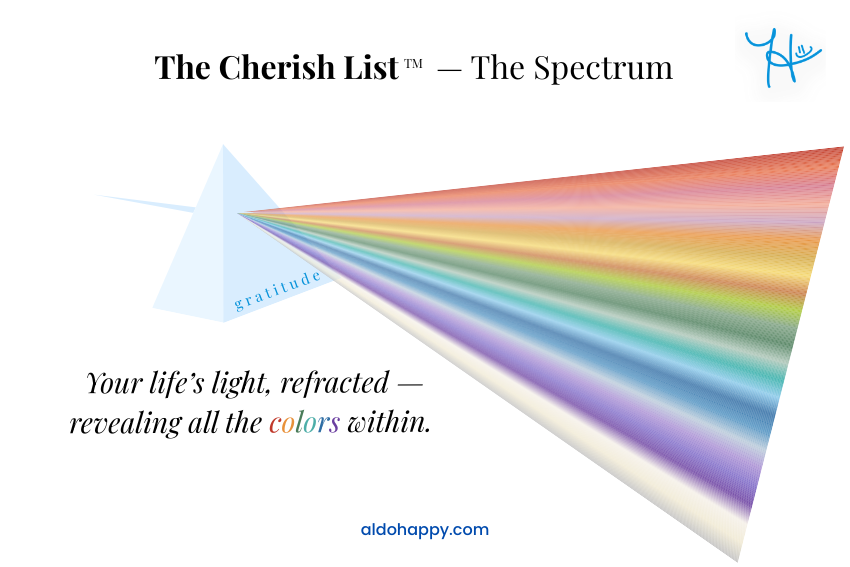
Your life’s light, refracted — revealing all the colors within. That’s the philosophy behind The Cherish List™. And it carries a quiet, important promise: your life already shines with colors, and the people who give it color are already there. The practice doesn’t create that. It helps you see them.
The Research
The Cherish List™ is built on three research-based principles. It helps to be clear about which parts are supported by research and which are rooted in philosophy. Each plays a role, but they are not the same.
Behavioral activation. Behavioral activation is a clinically validated approach to psychological well-being. Some studies show it is as effective as medication for anxiety and depression. Its key insight is that we don’t have to feel something first in order to act. We act first. The feeling follows. The Cherish List™ takes that principle and makes it relational: you notice and record even before you feel ready. The practice of paying attention is what generates the feeling of gratitude, not the other way around.
Expressing gratitude benefits both people. Research consistently shows that expressing gratitude benefits both the giver and the recipient. The giver experiences increased well-being, stronger relationships, and a greater sense of connection. The recipient feels seen, valued, and more likely to continue showing up. This is not a one-way gift. It’s a loop that strengthens both people.
Handwriting and memory. Writing by hand is slower and more deliberate than typing. That slowness is a feature. Research suggests that handwritten notes engage memory encoding more deeply: you process what you’re writing instead of simply transcribing it. Whether handwriting is more meaningful than typing is a value judgment, not a research finding, but the evidence that it encodes memory differently is real. When you write down what someone did and what it meant to you, you’re not just recording it. You’re choosing to remember.
The physical object. There’s also something worth naming that research alone can’t fully capture: the value of a physical thing you can hold. A page you can return to, reread in your own handwriting, that grows into a record of your attention and love. That object has a presence that a phone notification does not. This is a philosophical claim, not a scientific one. We honestly believe the physical object is valuable.
How The Cherish List™ Works
The Cherish List™ is a consistent practice with three phases: notice, record, honor.
1. The Overview Page
Start with the people who matter to you: family members, friends, the neighbor who always waves hello. Write their names. There’s no right order or number. Start with whoever comes to mind.
Then set your threshold. How many moments do you want to collect before you do something to acknowledge that person? Circle a number between 1 and 10. There’s no wrong answer. The threshold is your commitment to yourself: when someone reaches this number, I will honor them.
Your job from there is to notice. When someone on your list does something worth remembering — not something grand, just the quiet, consistent ways people show they care — fill in one of their tally hearts. Then open their Person Page and record the moment.
2. The Person Page
Each person gets their own page, front and back. Every time you fill in a tally heart, turn to this person’s page and write about what they did: the date, the moment, and what it meant to you. Write enough to remember.
The practice lives here, in your writing. In the act of choosing, in your own words and your own handwriting, to record what you saw.
3. The Honoring Moment
When someone reaches their threshold, you’ll have something remarkable: a record of every moment you chose to remember. Read through their Person Page. Then do something to express genuine gratitude: write a note, make a call, or offer a gesture. Choose whatever feels right.

Most gratitude practices stop at noticing or journaling. They’re internal. The Cherish List™ closes the loop. The practice ends with an outward act toward a specific person. That closing loop is what makes it relational rather than solitary. It’s the difference between feeling grateful and actually cherishing someone.
The honoring block at the bottom of the Person Page is where you record what you did and what it felt like to express your gratitude.
Notice. Record. Honor. Repeat.
The Spectrum: A Bonus Practice
As you practice The Cherish List™ over time, something shifts. You see that each person in your life brings something distinct, a quality that is recognizably, specifically theirs. The Spectrum is the bonus practice that helps you name it.
We’ve identified 25 colors, each one a different kind of relationship and presence. Not personality types. Not categories. Colors. The way a color feels in a room. The particular light a person brings.
You don’t choose the color. The moments do. As you notice and record, the person’s color reveals itself. When it does, you place a heart sticker in that color on their page, marking what gratitude helped you see.
When your My Spectrum Page is complete, or even partly complete, you’ll have something worth keeping. You’ll have your whole life’s light, in color, on one page. The people who give it color, named and claimed.
What The Cherish List™ Actually Does
Beyond the practice itself, The Cherish List™ does something more fundamental. It changes what you pay attention to.
Once you start keeping a list, you start looking for the moments. You catch what’s otherwise fleeting. The practice of noticing doesn’t just record gratitude: it generates it. This is what cultivating gratitude looks like: not a feeling you wait for, but a habit you build. Your life starts to feel fuller and more specifically colored because you finally see what was always there. The positive effects accumulate: more joy, less stress, and stronger connections with those who matter most.
Your life already shines with colors. This is how you learn to see them.

How to Start
The Cherish List™ is a free download. Print the Starter Kit and as many copies of the Person Page as you want (we recommend printing these double-sided).
Write one name. Set a threshold. Then notice the first moment worth remembering. It won’t take long.