

I have a confession.
When I was a medical student in the thick of Step 1 boards — nonstop studying, nothing sticking, running on fumes and anxiety — my counselor gave me some advice I didn’t want to hear:
Go outside for a walk.
I thought she had lost her mind. I barely had time to breathe, let alone wander around outside. A walk felt like a waste of time I didn’t have. I was so frustrated that I switched counselors.
I didn’t go on the walk.

I think about that moment a lot now, because I’ve since spent a lot of time building an app whose entire scientific foundation is essentially: go on the walk. Do the small thing. The tiny action you’re convinced won’t help. The one that feels pointless when your mood is low, and your energy is gone, and you can’t imagine how five minutes outside could possibly matter.
It matters. The science says so. And so does every version of me that has since learned — sometimes begrudgingly — that it works.
Here’s what’s actually happening when you can’t make yourself do anything.
The Trap Nobody Warns You About
When you’re depressed, burnt out, lost, anxious, or just going through something hard, the natural instinct is to pull back. Cancel the plans. Stay home. Skip the gym. Avoid the thing you’ve been putting off. It feels protective, like you’re conserving the little energy you have left.
But withdrawal is a trap.
The less you do, the fewer opportunities you have for positive experiences. The fewer positive experiences you have, the worse you feel. The worse you feel, the less you want to do — and more inactivity follows, almost automatically. It’s a vicious cycle that tightens quietly until one day you realize your world has gotten very small.
This isn’t a character flaw. It’s not laziness. It’s not weakness. Understanding that changes everything because it means the way out isn’t through willpower, positive thinking, or waiting until you feel ready.
The way out is through action. Small, specific, chosen action.
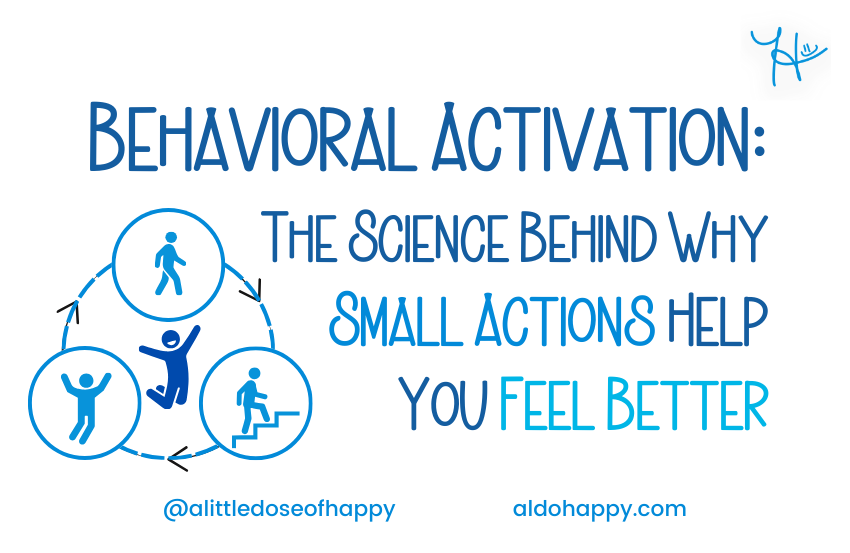
That’s behavioral activation.
Who This Is For
Behavioral activation was originally developed for clinical depression and other mood disorders, with strong supporting evidence. The research has expanded considerably since then, and so has our understanding of who these principles actually help.
Studies show that behavioral activation is effective for anxiety and post-traumatic stress, and for grief. A 2010 meta-analysis confirmed that the core principles apply even without a formal diagnosis, finding that behavioral activation improved well-being equally for clinical and non-clinical participants.
You don’t have to be at rock bottom. You don’t need to have a diagnosis. Most of us are carrying more than we let on — the daily weight of a busy life, a complicated world, and the quiet sense that something could be better, even if we can’t quite name what.
If you aren’t feeling like yourself, this is for you.
What Behavioral Activation Is
Behavioral activation is an evidence-based approach rooted in clinical psychology. It works by interrupting the withdrawal cycle at its source. Instead of waiting to feel motivated before you act, you act first — and let your mood follow.

I know that sounds backwards. We’re taught that motivation comes before action. But when your mood is low, waiting for motivation usually keeps you stuck. The behavioral activation model reverses this: you don’t need to feel like going for a walk; you just need to go for a walk.
Developed in the 1970s by psychologist Peter Lewinsohn and later expanded by researchers including Neil Jacobson and Christopher Martell, behavioral activation therapy emerged from a deceptively simple observation: low mood thrives in the absence of positive reinforcement from the environment. When people stop engaging with their lives, even for understandable reasons, they lose access to the experiences that naturally sustain a better mood. Behavioral activation deliberately and systematically restores that access.
What makes behavioral activation distinct from other approaches is its focus on the relationship between behavior and environment. It doesn’t begin with thoughts. It begins with actions — and the measurable changes those actions produce in how you feel.
Why We Resist (And Why That’s Okay)
Here’s something nobody puts in the pamphlet: knowing that something will help and actually doing it are two completely different things.
Most of us have been given good advice at the worst possible moment. When you’re overwhelmed, exhausted, or just going through something hard, the suggestion to take a walk, call a friend, or do anything beyond just surviving the day can feel almost offensive. Like the person offering it doesn’t quite grasp the size of what you’re carrying. So you nod, and you don’t do it, and somewhere in the back of your mind, you file it under things that work for other people.
This isn’t weakness. It isn’t stubbornness, exactly. It’s something more fundamental: when we’re stressed or depleted, the part of our brain that receives and integrates new information is essentially offline. Research on stress and the prefrontal cortex shows there’s a real neurological reason why good advice bounces off us at precisely the moments we need it most — the brain region responsible for taking in and acting on new information is among the first to be compromised under stress.
And then there’s something else — something very human. We need to feel like the authors of our own lives. Borrowed wisdom, however sound, feels like someone else’s story. Our own hard-won lesson, even if it’s identical to the one we were offered, feels like ours. So sometimes we have to find out for ourselves. That’s not a flaw in our character. It’s just being human.

The reason any of this matters is that behavioral activation is uniquely suited to skeptics. You don’t need to believe it will work, or feel optimistic, motivated, or open-minded. It simply asks you to act — letting your own experience demonstrate its effectiveness.
The belief can come after. It usually does.
The Science
What the Research Shows
Behavioral activation has been studied for decades, and the evidence is unusually consistent.
A landmark component analysis study published in the Journal of Consulting and Clinical Psychology found that the behavioral activation component of cognitive behavioral therapy (CBT) alone produced outcomes equivalent to the full cognitive behavioral treatment package, including for patients with severe depression.
Multiple systematic reviews and meta-analyses of randomized controlled trials have confirmed these findings. Behavioral activation has proven to be as effective as CBT and antidepressant medication for major depressive disorder, with particularly strong outcomes among those who haven’t responded to other treatments.
Brief behavioral activation treatment — structured protocols as short as eight to twelve weekly sessions — has demonstrated clinically significant results, with effectiveness that makes it one of the more accessible evidence-based interventions available.
Taking a walk to feel better isn’t folk wisdom. It’s the distilled output of decades of careful research. When the science is this consistent, it’s worth taking seriously.
Why It Works
Here’s how behavioral activation for depression works, and why the same mechanism applies far more broadly.
Depression and low mood don’t just feel bad. They actively narrow your world. Avoidant behavior feels protective in the moment — skip the party, cancel the plans, stay in bed. But avoidance operates through negative reinforcement: it temporarily reduces distress, which makes avoidant behavior more likely next time. The risk is cumulative. Over time, inactivity leads to less contact with your environment, fewer positive experiences, more social withdrawal, and a deepening of the very symptoms it was meant to soothe — a pattern that research consistently finds among depressed individuals and anyone caught in prolonged withdrawal.
Behavioral activation targets this vicious cycle directly. By gradually reintroducing meaningful activity — not random busyness, but valued actions that connect to what actually matters to you — you increase engagement with the experiences your low mood has been blocking. Your mood improves, not because you thought your way there, but because you acted your way there.
The mechanism is environmental, not cognitive. You are not trying to feel differently about your life. You are changing what your life contains, and your nervous system responds accordingly.
How It Differs from Cognitive Therapy
Cognitive behavioral therapy targets negative feelings by identifying and changing distorted thought patterns.
Both approaches work, and they’re frequently combined in clinical psychology practice. The difference is simply where you start. Cognitive therapy begins with thoughts: identify the distortion, examine the evidence, reframe. Behavioral activation begins with actions: do something meaningful, and let your mood and thoughts follow.
For many people — especially when low mood is severe, or when examining and challenging thought patterns requires more than you currently have — starting with behavior is more accessible. You don’t have to believe the walk will help. You just have to do it.
I didn’t believe it would help either. I was wrong.
How Behavioral Activation Works in Practice

Behavioral activation is structured without being rigid. Mental health professionals typically deliver it over weekly sessions, but the core principles can be practiced independently. The process generally looks like this:
Step 1: Monitor Your Current Activities (Activity Monitoring)
Before changing anything, observe. Keep a simple log — on paper, in your phone, wherever — of your daily activities and how you feel before and after. Spend a week doing this before you try to change anything. Most people discover that certain activities reliably shift their mood, while others quietly make things worse. The goal here is curiosity, not self-criticism.
Step 2: Find Meaningful Activities
This isn’t about filling your calendar. It’s about connecting to valued activities — ones that give you a sense of purpose, pleasure, accomplishment, or connection. For one person, that’s a real meal cooked at home. For another, it’s ten minutes outside, a text to a friend, time with family, or fifteen minutes on an old interest they’ve set aside. Small and specific beats grand and vague every time.
Step 3: Schedule Before You Feel Ready
Don’t wait for motivation. Choose an activity, choose a time, show up. The commitment comes before the feeling — not after. This is the part that feels most counterintuitive and is, in practice, the most important.
Step 4: Start Smaller Than You Think You Need To
One walk. One text. Five minutes on something that used to matter. The goal at the beginning isn’t transformation. It’s evidence — proof to your own nervous system that action is possible, that something small can shift something real. Breaking the goal into smaller steps makes each one more reachable, and each small success builds on the last. If calling a friend feels too big, try sending a voice note. If cooking feels impossible, just make some tea. The smallest version you can actually do today is the right version.
Step 5: Use Problem Solving for Obstacles
Avoidance has a way of finding reasons. When you notice resistance — I’m too tired, it won’t help, I’ll do it tomorrow — treat it as a problem to solve rather than a verdict to accept. What would make this action 10% more possible? What’s the smallest version of this you could actually do today?
Step 6: Stay Curious, Not Critical
Over time, you refine. What’s helping? Where is avoidant behavior sneaking back in? Are different activities landing better at different times? The practice isn’t about perfection — it’s about paying attention, and continuing to engage with your own life, even on the days when it asks more than you feel able to give.
A Note on Getting Support
While these principles can be practiced independently, working with a therapist trained in behavioral activation provides structure, accountability, and personalized guidance — especially for moderate to severe depression or other mental illness. Weekly sessions with a trained clinician can make a meaningful difference in outcomes. Look for therapists who mention behavioral activation, CBT, or behavioral therapy. Many offer virtual sessions if showing up in person feels like too much right now.
For education and self-directed work, Overcoming Depression One Step at a Time by Michael Addis and Christopher Martell offers a structured, evidence-based guide to applying these principles on your own.
The Walk I Eventually Took
I didn’t take the walk for a long time after that. Medical school became residency, which became life as an attending physician, and somewhere in there, I found my way into a gym — honestly, probably lured in by a cheap membership — where I started taking group dance classes. Not something I ever would have predicted for myself, but I loved it.
Then the pandemic closed the gyms. And I started walking around my neighborhood instead.

I look forward to those walks every day now. That’s the whole transformation — no epiphany, no dramatic turning point. Just a cheap membership, a closed gym, and one foot in front of the other. The person who once switched counselors rather than take a walk, frustrated by advice she wasn’t ready to hear, now can’t imagine her days without one.
Nobody handed me a behavioral activation plan. I just kept finding small entry points — accidental ones, most of them — and taking them. That’s how it usually works. Not a revelation. Just circumstances you didn’t choose, leading somewhere you didn’t expect, becoming something you look forward to every day.
The Only Thing You Need to Remember
All it takes is a little dose of happy.
Not a dramatic overhaul. Not a perfect morning routine. Not a complete reinvention of your life.
Just the tiniest action, chosen with intention, in the direction of something that matters to you.
A walk you didn’t want to take. A text you almost didn’t send. Five minutes on something you’d forgotten you loved.
That’s where it starts.
Your mind will tell you it won’t help. That you might as well not bother. That the walk is a waste of time you don’t have.
I believed that once too.
I was wrong. And I think — if you give it a chance — you might be wrong about it too.
Amy, wherever you are — thank you. I wasn’t ready to hear it then. I spent the next decade and a half proving you were right. 🩵
If any of this resonated, you’re already closer than you think. Start where you are. The a little dose of happy library is full of small, science-backed ideas for doing exactly that — and every article is written with the same philosophy: small actions, real science, no pretense.
And if you want to know when the Do Happy app is ready — built around everything in this article, designed to make the small actions as easy as possible — you can join the waitlist here. We’ll let you know the moment it’s available.