

There’s a moment most of us know — standing somewhere ordinary, a kitchen counter, a parking lot, a hospital corridor — when something shifts. A strange lightness. A sudden awareness of how much is here, right now, that you didn’t earn and don’t always notice. The morning light. Someone who loves you. The fact that your lungs keep working without you asking them to.
That moment is gratitude.
Here’s what the research keeps revealing, and what most advice about gratitude misses: gratitude isn’t something that just happens to you. It’s something you can build. Deliberately, practically, one small action at a time.
That’s what this article is about: why gratitude matters, how the science works, and how to build it.

What Gratitude Actually Is (and Isn’t)
Most of us have an instinct for gratitude — a sense that noticing what’s good is worthwhile. Researchers have spent decades studying exactly why, and their definition is quite specific.
Psychologists Robert Emmons and Michael McCullough, whose foundational work launched much of the modern science of gratitude, define it using attribution theory. Gratitude, they say, involves two steps: 1) recognizing that something good has happened, and 2) recognizing that the source of that good lies at least partly outside yourself. Another person. A turn of circumstance. Something you received rather than engineered.
That second part is what makes gratitude distinct from simple satisfaction or pride. It orients you outward — toward people, toward the world, toward something larger than your own effort and control.
It’s also what separates gratitude from relief. When we say ‘I’m so grateful I don’t have to struggle’ or ‘I’m grateful I wasn’t in that situation,’ we’re actually expressing relief, not gratitude. Relief is focused on the absence of something negative. Gratitude is about the presence of something good. Both are valid responses to life — but only gratitude, practiced consistently, produces the lasting changes in well-being that the research documents.
Gratitude is also not the same as toxic positivity. It doesn’t pretend that hard things aren’t hard, or perform cheerfulness in the face of genuine pain. A grateful person isn’t someone who denies negative emotions — they’re someone who has learned to hold those emotions alongside a genuine recognition of what’s good. The most compelling research on gratitude comes from people navigating loss, illness, and difficulty — people who found that practicing gratitude didn’t erase their struggles, but changed their relationship to them.
What the Research Says
The science of gratitude is worth knowing in some depth — both because it’s genuinely fascinating, and because understanding why something works makes you far more likely to do it.
Gratitude and mental health. In a landmark series of studies, Emmons and McCullough asked participants to write weekly about things they were grateful for, things that had hassled them, or neutral life events. After ten weeks, those in the gratitude condition reported higher levels of positive emotion, more optimism about the upcoming week, fewer physical complaints, and more hours of exercise. Their overall mental health improved, and participants described a more positive outlook on their lives.
Gratitude rewires negative bias. Our brains evolved with a negativity bias — we’re wired to notice what’s wrong faster than what’s right, to remember bad experiences more vividly than good ones. This served our ancestors well on the savanna. It serves us less well in modern life, where it manifests as rumination, anxiety, and a chronic low-level sense that something’s wrong. Gratitude practice works in part by intentionally counteracting this bias, training attention toward the positive aspects of life without ignoring the negative. It’s not denial; it’s recalibration.

Gratitude and the social brain. Some of the most interesting gratitude research focuses not on journals and reflection, but on expressed gratitude — thank you notes, direct acknowledgment, telling someone what they mean to you. Studies by Sara Algoe and colleagues at the University of North Carolina found that expressed gratitude functions as a “relationship booster”—strengthening relationships, improving emotional well-being for both people involved, and deepening mutual care. Gratitude, at its most powerful, is relational.
Gratitude and sleep. Research published in the Journal of Psychosomatic Research found that grateful people fall asleep faster, sleep longer, and report better sleep quality — because they have more positive thoughts and fewer negative ones as they drift off. If you’ve ever lain awake replaying the day’s frustrations, you already understand why redirecting attention before sleep would matter.
Gratitude and happiness. Martin Seligman, one of the founders of positive psychology, identified the “gratitude visit” — writing a detailed letter of thanks to someone who’s never been properly thanked, then reading it aloud to them — as one of the highest-impact interventions in his research on well-being. Participants reported significant increases in happiness and decreases in depressive symptoms up to a month after the exercise. In a study of 577 participants tested over six months, the gratitude visit was among the most immediately powerful interventions tested.
One important note: most of this research involves healthy adults navigating ordinary life challenges. Gratitude practice is a complement to clinical care, not a substitute for it. If you’re navigating significant depression or anxiety, these practices can be a meaningful part of your toolkit — but please work with a mental health professional too.
How Behavioral Activation Explains It All
Here at a little dose of happy, our aldohappy (“all do happy”) framework is built around a principle from behavioral activation therapy: action precedes feeling.
We typically think of it the other way around. We wait to feel grateful before expressing gratitude. We wait to feel motivated before we act. But the neuroscience points in the other direction. Behavior shapes emotion. When you act grateful — when you write it down, say it out loud, do something kind — your brain responds. Mood follows motion.
This is why gratitude “practices” matter so much more than gratitude “feelings.” Feelings are unreliable. On a hard day, you won’t feel like counting your blessings. You won’t feel like writing in a journal. You won’t feel like calling the person you’ve been meaning to thank. But if you act anyway — if you do the small, concrete, specific action — the feeling often follows. Not always. But more often than you’d expect.
The practices below are designed with this in mind. Each one is small enough to do on a difficult day, specific enough to actually do, and grounded in the research on what works.
How to Cultivate Gratitude: What the Research Supports
1. Keep a Gratitude Journal — But Be Specific
The gratitude journal is probably the most studied practice in positive psychology, and for good reason: it works. But there’s a meaningful difference between journaling that produces lasting change and journaling that becomes repetitive. Gratitude quotes can help you find the feeling before you begin — but the real shift comes from how you write, not just that you write.
Specificity matters more than frequency. Writing “I’m grateful for my family” every day for a month has diminishing returns. Writing about why you’re grateful, what would be different without this person or thing, what specific moment reminded you of it today — that’s where the shift happens. It’s the difference between performing gratitude and actually feeling it.
And doing it too often can backfire. Sonja Lyubomirsky’s research found that journaling once a week produced greater happiness gains than journaling three times a week — likely because less frequent reflection keeps the practice feeling fresh rather than obligatory. Once something becomes fully routine, it stops registering.
Gratitude journaling once a week, done with care, is enough. Our gratitude journal prompts can help you keep each entry feeling fresh. And, if you want somewhere to capture the things that keep coming up, an ongoing gratitude list is a natural companion to the practice.

2. Count Your Blessings — Carefully
“Count your blessings” sounds simple. The research behind it turns out to be surprisingly specific. The exercise works best when paired with a specific cognitive move: mentally subtracting the good thing from your life, rather than just listing it. Instead of “I’m grateful for my health,” you imagine a morning where your body couldn’t do what you asked of it — not to generate anxiety, but to counteract adaptation, the tendency to stop noticing what we’ve gotten used to.
The good stuff becomes invisible not because it’s gone, but because we’ve adjusted to its presence. The job, the friendship, the fact that someone is there when you come home — these things quietly become baseline. When you notice what you have by imagining its absence, the gratitude becomes vivid again.
Mental subtraction works with past events too — relationships, opportunities, or chapters of your life that you’ve moved through and stopped noticing. What would the trajectory of your life look like without that person, that chance, that turning point?
Our list of everyday happy things can help you remember what’s already there.
3. Keep a Gratitude Jar
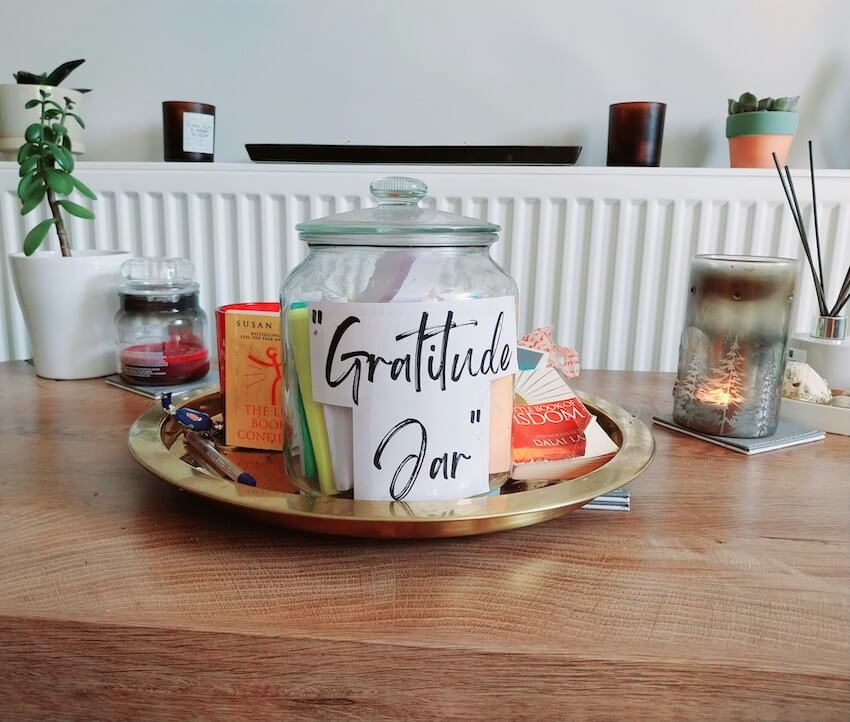
The practice is simple. Keep a jar somewhere you’ll see it — kitchen counter, beside the bed, on a desk. Whenever something good happens, write about it on a slip of paper and drop it in. A conversation that felt alive. A moment of unexpected beauty. A small win. Someone who came through. It doesn’t need to be significant. It just needs to be real.
The jar’s power comes from two things. First, the physical act of writing and depositing anchors the positive experience in a way that a mental note doesn’t. Second, the accumulation becomes evidence. On a hard week, when you can’t remember the last good thing, you can pull out a handful of slips and discover that more has been good than you remember.
Many people choose to empty the jar at the end of the year — reading back through everything as a quiet way to see the year whole. Not as the hard patches. But as a record of all that was good.
The gratitude jar also translates beautifully to households. A family jar builds shared memory as each person contributes their own slips. A couple’s jar becomes its own private archive. And children can participate too — the habit of noticing and naming good things, started young, is one of the more lasting gifts you can build into daily life.
4. Celebrate Small Wins
This one sits at the intersection of gratitude and behavioral activation, which is why it belongs here.
We live in a culture that almost exclusively rewards large outcomes — the promotion, the finished project, the milestone reached. The thousand small steps it took to get there are largely invisible, even to us. This creates a permanent sense of not-quite-there, a chronic background dissatisfaction even when things are genuinely going well.
Noticing and celebrating small wins does something specific: it trains your attention toward progress rather than deficiency. It interrupts the negativity bias. And it generates positive emotion in real time, not just in retrospect. Over time, this builds a positive mindset — not through positive thinking as an act of will, but through a record of how far you’ve actually come.
5. Write a Gratitude Letter — and Deliver It
Of all the gratitude practices studied, this one may be the most powerful. And it’s the most commonly avoided, because it requires vulnerability.
The exercise: think of someone who has profoundly shaped your life for the better and has never been fully thanked. A teacher. A mentor. A friend who showed up during your worst chapter. A parent. Even a stranger whose small kindness you’ve carried with you for years.
Writing letters of this kind takes conscious effort — it asks you to excavate something real and put it into words. Not a quick note, but a genuine letter. Specific. Honest. Tell them what they did, how it affected you, and who you became partly because of them.
Then, if at all possible, deliver it in person and read it to them.
Seligman’s research found that this single exercise produced one of the largest and most durable happiness boosts among the interventions he tested. The effect lasted for weeks. People wept — the giver and the recipient both. And the relationship deepened, often in ways neither expected.
If you feel the gap between what you feel and what you’re able to say, our guide to closing the gratitude gap walks you through it with specific exercises. And for finding the right words, our collection of thank you messages offers a starting point you can make your own.

6. Perform Acts of Kindness
The relationship between gratitude and kindness runs in both directions, and this matters.
When you’re grateful, you’re more likely to be kind — you’re oriented outward, aware of what you’ve received, primed to give. But the reverse is also true: acting kindly generates gratitude. A kind gesture toward someone else creates a moment of connection, a sense of meaning, a small proof that you can make things better. And that experience circles back as appreciation — for your own capacity to contribute, for the person you helped, for the world that contains the possibility of these exchanges.
The research on prosocial behavior consistently shows that giving is among the most reliable routes to subjective well-being. Not because it’s altruistic and therefore virtuous, but because it works, neurologically and emotionally. The helper benefits as much as the helped.
7. Reframe — Without Bypassing
There’s a version of reframing that works harder and is more honest than positive thinking — and far more useful. It doesn’t ask you to find the silver lining. It asks: given that this hard thing is real, what else is also real? Not instead of the difficulty. Alongside it.
That’s different from the version most people know — forcing a silver lining onto genuine pain, insisting every setback is secretly a gift. That’s not gratitude. That’s avoidance wearing gratitude’s clothes.
Viktor Frankl, writing from the depths of experience no reframe could fully address, observed that meaning can be found even in suffering — not because the suffering is good, but because the human capacity to orient toward something beyond it is real. Gratitude is what that orientation looks like in practice. It doesn’t deny loss. It refuses to let loss be the only truth.
When you’re in the middle of something hard, you don’t have to be grateful for it. But you might find, if you look carefully, things to be grateful for during it.

8. Adjust Your Expectations
We adapt so quickly to what we have that it stops feeling like having and starts feeling like baseline. The car, the health, the relationship, the salary — whatever we once wanted becomes what we simply have, and we recalibrate upward.
Psychologists call this the hedonic treadmill. It’s not a character flaw; it’s how we’re built. But it does mean that gratitude requires some friction against our natural drift.
Deliberately revisiting expectations — asking “what did I hope for a year ago that I now take for granted?” — is one of the more honest approaches to fostering gratitude that doesn’t depend on everything going right. A simpler version of the same practice: notice where you say “I have to” and try “I get to” instead. I have to go to work. I get to go to work. It doesn’t work for everything. But in the right moment, that single word finds the gift inside the ordinary thing.
Our collection of gratitude affirmations can serve as a daily touchstone to redirect your attention to what you already have.
9. Forgive — Because Resentment Costs Too Much
This is the hardest practice on this list, and the one most connected to sustained gratitude.
Resentment and gratitude cannot comfortably coexist. When we hold on to grievances — about others, about ourselves, about life’s basic unfairness — we maintain a filter that screens out good. We see everything through the lens of what was done, what wasn’t given, what we deserved and didn’t get. And in that state, gratitude becomes genuinely hard to access.
Forgiveness doesn’t mean the wrong didn’t happen. It doesn’t require reconciliation, approval, or forgetting. What it means — what the research suggests — is releasing yourself from the role of carrying it. The grudge costs the holder more than the offender, almost always.
Self-forgiveness belongs here too. Many people find it easier to forgive others than themselves. But the same logic applies: when you can’t forgive yourself, it’s hard to feel grateful for who you are now.
10. Invest in Your Relationships — and Express It
Ask most people what they’re most grateful for, and the answer is rarely a thing. It’s almost always a person. The ones who show up. The ones who know us. The ones we’ve shared something real with.
This means cultivating gratitude and cultivating relationships are not separate projects. They feed each other. When you tend to the people you love — with attention, with expressed appreciation, with the small, reliable acts of care that relationships are made of — you strengthen relationships and build the conditions for more gratitude at the same time.
Algoe’s research on couples found that everyday gratitude acts as a booster shot for relationships — when one partner does something thoughtful, and the other feels gratitude for it, both partners report greater connection and satisfaction the following day. The small, considerate things matter more than you might think.
And so does saying something. A separate line of research found that when partners expressed gratitude directly to each other, it predicted improvements in relationship quality over 6 months. When we tell people we appreciate them — not in grand gestures, but in ordinary, everyday moments — it changes both of you. The person receiving it feels seen. The relationship deepens. And the act of articulating what someone means to you reinforces your own awareness of their value.
This doesn’t require much at all. A text that says ‘I was thinking of you today and I’m glad you’re in my life.’ A handwritten note slipped under someone’s door. A small, thoughtful gift that communicates ‘I noticed what you love.’ These are tiny acts, but they carry Algoe’s ‘find, remind, and bind‘ dynamic — they locate the person as someone worth holding on to, and they draw them closer. And if you need inspiration, we have ways to say thank you for every relationship and every moment.

A Note on Hard Days
There are days when gratitude feels not just distant but insulting — when the suggestion to count your blessings lands like an accusation that you’re not trying hard enough. When everything on this list feels like one more thing you’re failing to do.
Those days are real. And they don’t mean the practice has failed, or that you’re doing it wrong.
On those days, the goal is not to feel grateful. It’s just to do one small, concrete thing. Write one line. Say one true thing. Do one kind act, however small.
Because this is what behavioral activation keeps teaching us: you don’t have to feel it first. You don’t have to be in the right mood, or at the right stage of healing, or sufficiently past what you’re going through. You just have to take the next small action. And then the next.
Gratitude is built in the doing, not the feeling. The feeling tends to follow.
Where to Start
If you’ve read this far and want to begin, here’s the simplest possible entry point:
Tonight, before you sleep, write down three things you’re genuinely grateful for. Make each one specific — not “my health,” but “the fact that I could take a walk this morning and my legs carried me.” Not “my friend,” but “the way she stayed on the phone with me until I felt better.”
Do that for two weeks. See what happens. And if you hit a day when you can’t think of anything to write, our gratitude journal prompts are there — 75 prompts to help you find what’s worth noticing.
If writing doesn’t feel like the right entry point, try a gratitude walk instead — a short walk taken with the specific intention of noticing what’s good. Not exercise, not errands. Just moving through the world looking for what’s worth appreciating. A tree. A sound. The way the light looks when the sun is starting to set. It’s a deceptively simple practice, and it works for the same reason everything else on this list does: attention directed toward the good, repeatedly, reshapes what you notice by default.
The Do Happy App was built for this — a quiet space to carry your gratitude practice with you, wherever the day takes you.
The Bigger Picture
Gratitude, at its deepest, is an orientation toward life — a fundamental stance that what’s here is worth noticing, that goodness is real even when it’s partial, that we are genuinely connected to each other.
That orientation doesn’t erase difficulty. It doesn’t perform happiness over pain. What it does is refuse to let difficulty be the whole story.
The research supports this. The practice supports this. And if you’ve ever had one of those moments — standing somewhere ordinary, the light shifting, when something you couldn’t quite name becomes clear — you already know it to be true.
Gratitude isn’t the silver lining. It’s the willingness to keep looking for what’s already there.