There are moments — often late at night, when the world is still, and your thoughts have nowhere to hide — when you find yourself wobbling on the finest of lines. On one side is hope. On the other: disappointment, despair, and the very real possibility that the thing you’ve believed in, worked for, poured yourself into, might not work out.
But you choose hope anyway.
That choice — that stubborn, irrational, beautiful choice — is perhaps the most human thing we do. It isn’t naive. It isn’t blind. It is, in the truest sense, audacious. Audacity: fearless daring. Bold courage. The willingness to step forward knowing full well what’s waiting on the other side if it doesn’t work out.
Hope is audacity. And audacity, it turns out, is the defining quality of being human. Audacity is not the absence of fear, but the decision to move forward in spite of it.
The Girl Who Came Back
In February 2026, twenty-year-old Alysa Liu stood on Olympic ice and won figure skating gold. It was a moment that, from the outside, looked like the inevitable culmination of extraordinary talent. But the story behind it is far more interesting — and far more human.
Alysa became the youngest U.S. figure skating champion in history at the age of thirteen. By sixteen, she was done. Not defeated — done. Skating had become everything, and everything, she understood instinctively, was too much. So she walked away. During a global pandemic, while the world was paused and uncertain, she chose to pause too. To breathe. To learn what else life had to offer.
She returned at eighteen. Not because she had to, but because she wanted to — on her own terms, with her own joy restored. Nobody saw what was coming. World Champion at nineteen. Olympic Gold at twenty.
In her own words, shared just days before standing on that podium: “The moral of the story is try to have a good balance. You shouldn’t be 100% in something and not exploring the rest of your potential. That would be doing yourself a disservice.”
And, with the kind of grace that can only come from someone who has genuinely made peace with uncertainty: “Things will play out the way they were meant to.”
That is not the philosophy of someone who doesn’t care. That is the philosophy of someone who has learned to hope without white-knuckling it. To act with full commitment and hold the outcome loosely. To understand, at twenty years old, something that most of us spend a lifetime trying to discover.
Her story is a perfect window into what it means to be human.
The Paradox We Live In
Here is the thing about hope that nobody tells you: it requires you to know, going in, that disappointment is right on the other side. You cannot hope without that knowledge. Hope without risk isn’t hope — it’s certainty. And certainty, for better or worse, is not something the human experience offers very much of.
This is the central paradox of human life: The light only means something because of the dark. We cannot have joy without sadness, connection without the risk of loss, or meaning without the possibility of failure. The win only feels like a win because of all the times it didn’t work out.
What philosophers and scientists have found, across centuries of inquiry into human nature, is consistent: we are not built for permanent happiness. We are built for contrast. For movement. For the oscillation between struggle and relief that keeps us genuinely engaged with the seeming chaos of being alive. The answer to why life feels hard, in other words, is that it’s supposed to. Not as punishment, but as design.
Too much of anything, it turns out, is its own kind of suffering. Unbroken ease breeds restlessness. Unbroken struggle breeds despair. Balance isn’t just good advice. It’s the fundamental rhythm of a life fully lived.
What Makes Us Uniquely Human
Across the full complexity of life on this planet, Homo sapiens occupy a singular position. We are not the fastest, the strongest, or the most physically resilient species. What we are is the most aware.
We have language — not just to communicate for survival, but to speak our truth, listen deeply, interact across vast distances of culture and experience, and say I love you in ten thousand different ways. We have curiosity that drives us to discover things far beyond what is required to live.
We are perhaps the only species that experiences boredom, and from that restlessness, creativity is born. We generate ideas that outlive us. We create art not because it feeds us but because it feeds our souls.
We develop moral frameworks, wrestle with the big questions of existence, and feel genuine guilt — not as a survival mechanism, but as evidence of our capacity for compassion. The power of human empathy, when we choose to exercise it, is among the most transformative forces in our world.
Empathy. Perhaps more than anything else, this is what connects us. The ability to imagine another person’s interior life. To feel, even imperfectly, what they feel. To be moved by the suffering of a stranger. To celebrate a friend’s joy as if it were our own. To want — genuinely want — for others to succeed alongside us.

That orientation — caring about the experience of others as deeply as our own — is uniquely, beautifully human. And it is, perhaps, the quality most worth protecting.
The Mirror We’ve Built
There is something quietly illuminating about the rise of artificial intelligence that rarely gets discussed in the conversations dominated by fear or fascination.
AI learns from human writing, human thought, and human expression at their most careful and intentional. It learns from the best of what we put into words. And now, in a strange inversion, people who write clearly — who care about language, who choose their words with precision and purpose — are being flagged as “too AI.” As if clarity and thoughtfulness have become suspicious. As if good writing is no longer a human trait but a machine one.
This says something worth sitting with. Not about AI, but about us. About what we’ve started to accept as the baseline of human expression. About the qualities — care, precision, empathy in communication — that we’ve allowed to feel exceptional rather than expected.
The most human thing of all is to care. To mean what you say. To show up with intention. If those qualities now read as artificial, perhaps that’s less a statement about machines and more an invitation to remember what we’re capable of, and to choose it.
The real thing is always recognizable. We know it when we encounter it. That capacity for recognition — for sensing authenticity — is one of the most essentially human gifts we possess.
The Fine Lines We Walk
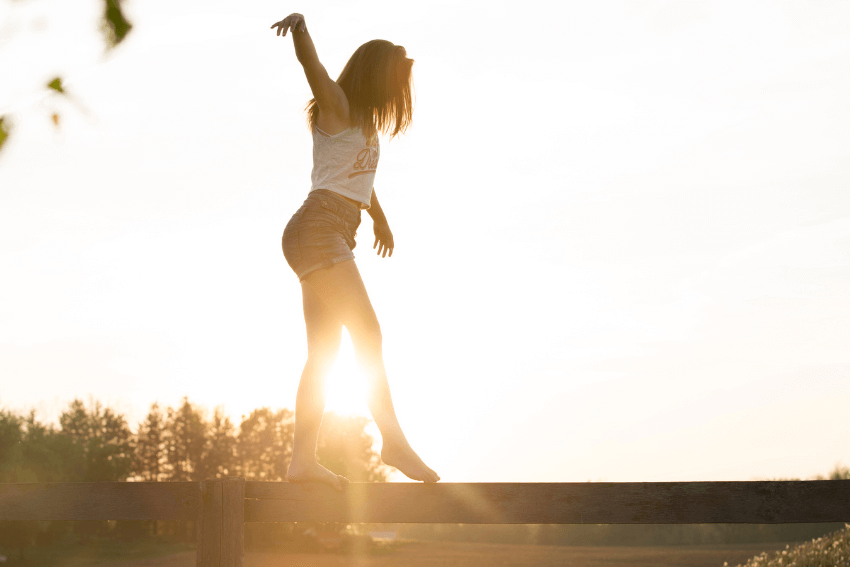
Being human means living on edges.
The edge between hope and disappointment is the sharpest. Hope requires vulnerability. It requires believing in a future that isn’t guaranteed, investing in an outcome you cannot control, and caring about something enough that losing it would hurt. Fear lives on this edge — the fear of trying and failing, of reaching out and being met with silence, of believing in something that doesn’t work out. Every person who has ever hoped for something and been let down knows that particular sting.
And yet, we hope anyway. We can’t seem to help it.
That is not weakness. That is audacity.
Alysa Liu walked her own fine lines — between dedication and balance, between the identity she’d built around skating and the fuller human being she wanted to become. Her struggles weren’t just athletic; they were deeply human. Who am I when I’m not this one thing? What path do I follow when the only one I’ve known no longer feels right? She didn’t resolve those tensions by choosing one side. She learned to walk the line — and eventually, to dance on it.
The edge between connection and isolation is another. We are wired for relationships — for being known and for knowing others. True connection requires risk: showing the parts of yourself you’re not sure will be accepted, reaching out when silence is safer, staying present when disappearing is easier. The vulnerability of that is real. And the reward — when connection is genuine — is among life’s greatest gifts.
These edges are not problems to be solved. They are the mark of a life fully lived.
Choosing the Light
Behavioral activation — a well-established approach in psychology — rests on a simple but profound idea: action shapes emotion. We do not wait to feel ready before we act. We act, and feeling follows. Our response to difficulty is not fixed. It is something we can shape.
This is deeply human. We are not passive recipients of our emotional lives. We are agents. We make daily choices that shape who we are and how we experience life. The path forward is rarely grand or obvious. It is usually small, and it is always a choice.
On the hardest days — and there will always be hard days — the most human thing we can do is take one small action toward the life we want. Not a grand gesture. Not a transformation. Just one deliberate step in the direction of the light.
That step might look like reaching out to someone who has been on your mind. It might be doing something that brings a sense of aliveness, even when motivation is absent. It might simply be choosing, consciously, against the weight of circumstances, to believe that things can be better.
This is not naive optimism. It is audacity. The hard-won, clear-eyed, deeply human audacity of hope.
A Love Letter to Humanity
We are all works in progress. Flawed and luminous. Capable of profound cruelty and breathtaking kindness, sometimes in the same breath. We build things and break things and build again. We feel too much and not enough. We carry losses that never fully leave us and joys that surprise us at the strangest moments.
And we keep going. Not because we’re certain it will work out. Not because the odds are always in our favor. But because something in the human spirit — stubborn, irrational, beautiful — keeps choosing to hope anyway.
Alysa Liu could have stayed retired. The world would have understood. Instead, she laced up her skates, stepped back onto the ice, and trusted that things would play out the way they were meant to. And they did! But even if they hadn’t, the act of returning, of choosing possibility over safety, was already the point.
That is what it means to be human. To exist at the intersection of vulnerability and resilience. To walk the fine lines between every opposing force. To feel the full weight of consciousness and choose, despite all of it, to remain curious and open and kind.
To hope — knowing full well what’s on the other side.
Maybe the goal was never to eliminate the darkness. Maybe it was always just to keep choosing the light — one small action at a time.
That’s the audacity of being human. The willingness to choose, even on the hardest days, a little dose of happy. And it’s worth everything.