
As an anesthesiologist, you have five minutes.
Five minutes before a patient surrenders consciousness. Before they close their eyes and trust you completely with their life. In those five minutes, you have to earn something that most relationships take years to build. You have to make a frightened human being feel safe enough to let go.
I once worked with an anesthesia tech, one of the best I’ve ever known and the person who sees everything from the sidelines, who confided to me about one of our physician leaders. Technically skilled. Respected by both anesthesiologists and surgeons alike. Powerful in every room he entered.
“He has terrible bedside manner,” she told me.
I was shocked. Not because I disagreed. But because I had assumed that at minimum, people would pretend. That the performance of caring would be baseline. That someone who chose medicine would understand, at a bone-deep level, that the patient in front of them was terrified and needed to feel seen before being wheeled back to the operating room.
He didn’t.
And I found myself wondering: How does someone practice anesthesiology without understanding what those five minutes require? Without the ability to hear what a patient is saying when they say they’re scared? Without registering the person’s emotions and responding with something comforting?

The answer, I’ve come to believe, is that somewhere along the way, he learned what too many of us are hearing: that empathy is weakness. That caring is less important than efficiency. That effective clinicians keep their distance.
He was wrong. So is anyone who taught him that. So are the systems that treat it as optional.
What Empathy Is
Empathy is not sentimentality. It is not losing your professional composure or drowning in someone else’s sadness. It is not caring so much that you cannot function.
Empathy is the ability to perceive what another person is experiencing — their pain, their fear, their anxiety, their confusion — and respond to it meaningfully. It requires presence, attention, and the willingness to be affected by what you observe, and then to act on it.
Researchers distinguish between several forms. Cognitive empathy means understanding another person’s perspective intellectually: the ability to step into someone else’s shoes and see the world as they see it. This matters in conflict resolution, where understanding what someone thinks and feels is the foundation of any path forward.
Emotional empathy, also called affective empathy, means feeling what another person feels, registering their emotional state in your own body without losing sight of your own feelings in the process.
Compassionate empathy combines both: you understand, you feel, and you are moved to offer support.
To empathize is not to lose yourself in someone else’s experience. It is to be present enough to register it, and moved enough to respond. Practicing empathy means moving through all three forms in the direction of action. It is one of the most active things a person can do.
What the Science Says
The research on empathy is unambiguous, and it dismantles the weakness narrative completely.
Patients of physicians with higher empathy scores have significantly better clinical outcomes, including lower rates of diabetic complications, than patients of physicians with lower scores. Empathy is not just kind. It is effective medicine, with benefits that extend far beyond how a patient feels in the moment.
Physician empathy is associated with greater patient satisfaction, according to an analysis of over 1,300 physician-patient interactions. When patients feel understood, they trust their physician, share more information, and follow through. Empathy improves the quality of the data physicians work with. It makes better medicine possible.
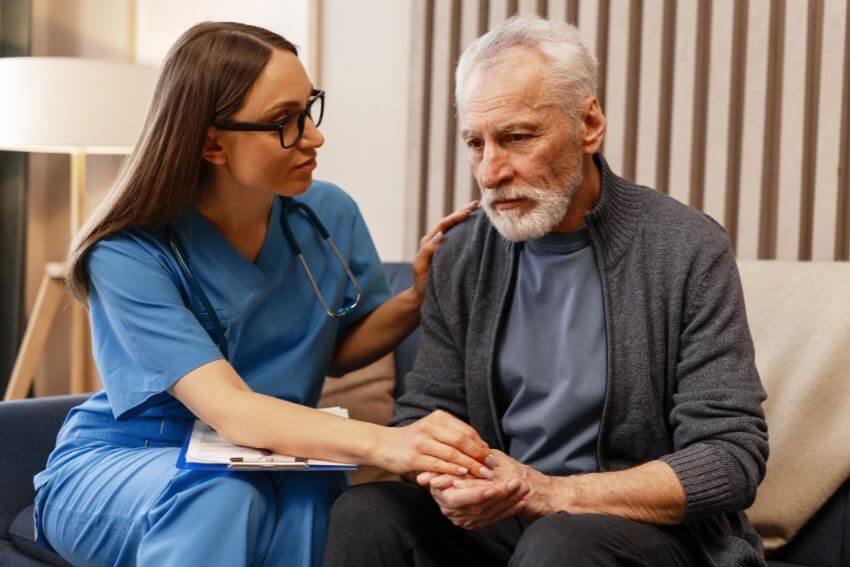
Beyond medicine, people who believe empathy is a learnable skill become more empathetic through effort, a finding from Stanford’s Social Neuroscience Lab that reframes empathy from a fixed personality trait into a capacity that can be developed. Embracing empathy this way changes everything about how we approach it.
And in leadership, a manager’s ability to understand their team’s personal circumstances is positively associated with job performance ratings. The empathetic leaders had better-performing teams. Empathy in the workplace is not a soft skill. It is a measurable advantage.
Ben
I want to tell you about Ben.
Ben is an orthopedic surgeon who does complex back cases: long, technically demanding surgeries that require everyone in that operating room to be at their best. He is, without question or competition, THE NICEST person I have ever had the privilege of working with. I will refer to him in this way with all caps for the rest of my life because he earned it.
Here is what Ben did.
I was running the operating rooms one day, managing cases, coordinating staff, keeping everything moving, and I had not eaten. This is not unusual in medicine. You get busy, you keep going, you don’t eat, you’re running on adrenaline and you tell yourself you’re fine.
Ben had a late case to start. He looked at me, really looked at me, and said:
“Manda, go eat. We can wait.”
No surgeon wants to wait. Particularly not an orthopedic surgeon about to begin a long back case in late afternoon. The culture of the surgical suite does not reward slowing down. Nobody stops. Nobody waits. You push through.
I told him I was fine.
He didn’t believe me.
So Ben, orthopedic surgeon, busy physician, person with every professional reason to start his case, produced a granola bar. He handed it to me. Because he had seen me, assessed the situation, and decided that another person’s well-being mattered more than his schedule.
A granola bar.
That is all it took. One small, specific, unrequested act of attention. And Ben officially became THE NICEST person I have ever known ever since. He didn’t perform some grand gesture; he simply noticed. He saw me as a human being dealing with a long and busy day, and he responded accordingly. He made me feel seen.
Ridiculous how little it takes.
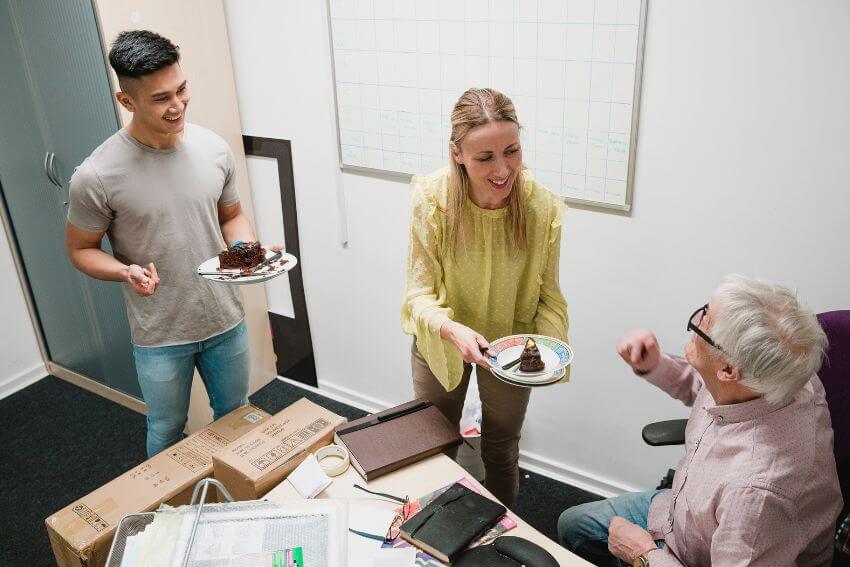
That is empathy in action. Precise. Practical. Exactly right. These are the kinds of empathy examples that don’t make headlines, but they shape how people feel about their work, their colleagues, and themselves for years. They build trust. They create the conditions where people feel safe enough to be honest, to ask for help, to bring their full selves to the room.
Sometimes, expressing empathy looks like a hug. Sometimes it looks like a granola bar. The form doesn’t matter. The seeing does.
When Caring Gets Called a Flaw
Not everyone sees empathy this way.
I once had a colleague who told me I “care too much.” She said it as a critique, as though caring in excess was a flaw to be corrected.
In my head, I responded calmly: I don’t care too much. Maybe everyone should care more.
There was a period in my career when I returned to help a group of colleagues being pressured to join a private equity group that has since made headlines for exactly the reasons I feared. I had an MBA. I understood what the numbers meant and what physician autonomy looked like after private equity consolidation. My colleagues needed someone to make that case clearly, and I did, even when it cost me personally, even when the timing was terrible. When the initial vote took place, the group voted no, despite leadership pushing hard for yes.
The private equity group’s story has since played out publicly. The outcomes for the practices that joined and for their patients were not good. My caring too much turned out to be very useful for the group.
Caring deeply, specifically, in the face of real stakes, is not sentimentality. It is one of the most important skills a person can bring to any situation, and the people around you feel its presence or absence in ways they may not even be able to name.
I have thought about my colleague’s words many times since then. I’ve decided that she was protecting herself. Detachment is armor, and medicine teaches us early that armor is necessary. I understand the instinct. When you are surrounded by suffering and dealing with people’s pain every single day, it makes sense that you would want to create distance. The weight of feeling another person’s emotions can be overwhelming.
But the armor comes at a cost. And that cost is paid by the patients, the colleagues, and the people around you who need someone to hear them, and find a wall instead.
Why EQ Matters More Than You Think
There is a concept that has reshaped how we understand professional effectiveness: emotional intelligence, or EQ, the ability to perceive, understand, manage, and use emotions effectively in relationships with others. This is distinct from sympathy, which is feeling sorry for someone, or from simply being pleasant. EQ is a sophisticated capacity for connection that draws on both cognitive and emotional empathy.
Emotional intelligence matters twice as much as technical skills and cognitive ability combined in determining outstanding professional performance. That gap only widens at senior leadership levels, where technical skill differences become negligible and emotional intelligence accounts for nearly 90% of what separates star performers from average ones. This analysis drew on competency data from hundreds of organizations.
IQ gets you into the room. EQ determines what happens when you’re there.
The physician with the terrible bedside manner was intelligent. Successful by conventional metrics. But the person who saw everything, the anesthesia tech who watches physician after physician come and go, knew the difference immediately. Patients knew. The nurses who worked with him directly knew.
High IQ. Low EQ. And a legacy measured not in what he achieved, but in how he made people feel.
That is not a trade worth making.
Practical Empathy Examples From Daily Life
Empathy in everyday life rarely looks dramatic. The most meaningful empathy examples are usually quiet: small moments of attention that land like something much larger.

It looks like a surgeon who notices that a colleague hasn’t eaten, decides that matters, and makes himself wait. It looks like producing a granola bar when someone insists they’re fine because you can see that they’re not.
It looks like a physician who takes an extra 30 seconds before a procedure to make eye contact with a patient and say, “I know you’re scared. We’re going to take good care of you.” That sentence, spoken with intention, changes everything about what is about to happen.
It looks like a friend who asks how you’re doing and waits for the answer, using active listening rather than waiting for their turn to speak. It looks like noticing non-verbal cues and body language: the way someone’s shoulders drop, the flatness in their voice, the particular kind of quiet that means someone is struggling and hoping someone will notice.
It looks like welcoming a new member of your team by learning something about who they are before you need anything from them.
It looks like staying present with someone’s sadness or anger without immediately trying to fix it, because sometimes what people need is not a solution but a witness.
It looks like a colleague who offers constructive feedback with enough care that you actually hear it.
It looks like showing up for people, even and especially when it’s inconvenient, because healthy relationships are built on precisely those moments.
In business settings, attending to a customer’s feelings, trying to understand what they’re experiencing rather than just processing their complaint, transforms what might have been a negative interaction into one where the customer feels heard. The same principle holds across every human context. When people’s emotions are acknowledged rather than bypassed, defenses come down. Trust goes up. Honest communication becomes possible.

Even small increases in empathetic behavior produce meaningful improvements in how people feel, how they heal, and how they trust, findings from evidence-based empathy training developed at Massachusetts General Hospital and Harvard Medical School. Empathy is powerful not because it requires enormous effort, but because it compounds.
Small acts. Lasting impact. Every time.
The Strength It Takes
Here’s the truth about empathy: it is not the easy path.
It is easier to stay detached. It is easier to move through a busy day without noticing whether the person next to you has eaten, without feeling another person’s pain, without caring whether the people around you feel understood. Detachment is efficient. It means you don’t have to slow down. It means you don’t have to be affected.
Empathy asks you to be affected. It asks you to prioritize someone else’s emotional state in a culture that rewards individual performance. It asks you to remain present with what is overwhelming, to offer support when someone is suffering, even when you’re struggling too, to imagine another person’s experience fully enough that you are moved by it.
That is not weakness. That is one of the most important skills you can develop. And it is, at its core, an act of courage: choosing connection over protection, presence over efficiency, caring over detachment.
The colleague who said I care too much was protecting herself. I say that with compassion. The detachment that medicine teaches is sometimes necessary. But it can become a habit that extends well beyond what the situation requires, until a physician walks into a room with five minutes and a terrified patient and cannot find a single thing to say that makes them feel less alone.
Empathy in daily life is associated with greater subjective well-being and more prosocial behavior. People who feel empathy from others report feeling more understood, more supported, and more capable of moving through difficult circumstances. And the benefits flow in both directions: the person who gives it and the person who receives it are both changed by the exchange.
The granola bar cost Ben nothing measurable. What it gave me, in my memory, in the standard I hold for how people should treat each other, is immeasurable. Ben is probably deeply embarrassed that I would even mention it, and in an article no less. I apologize for any embarrassment, but I stand by my desire to give him credit where it is definitely due.

For Anyone Who Was Told That Caring Too Much Is a Flaw
If you work in medicine or in any field where the culture tells you that caring too much makes you soft, I want to say this directly:
The patients remember. The colleagues remember. The person who sees everything from the sidelines, who notices the difference between those who care and those who don’t, remembers.
Your IQ got you here. Your EQ determines what happens next.
The importance of empathy is not abstract. It lives in the five minutes before a patient goes to sleep. It lives in the granola bar. It lives in the person who showed up and fought for her colleagues even when it cost her, because caring is not a flaw. It is the point. And its impact on mental health, on how people feel about themselves and the people around them, is not a side effect. It is the whole thing.
Today, find one person who is having a tough time. Don’t fix it. Don’t advise it. Just hear them. That is where it starts.
Be Ben. 🩵