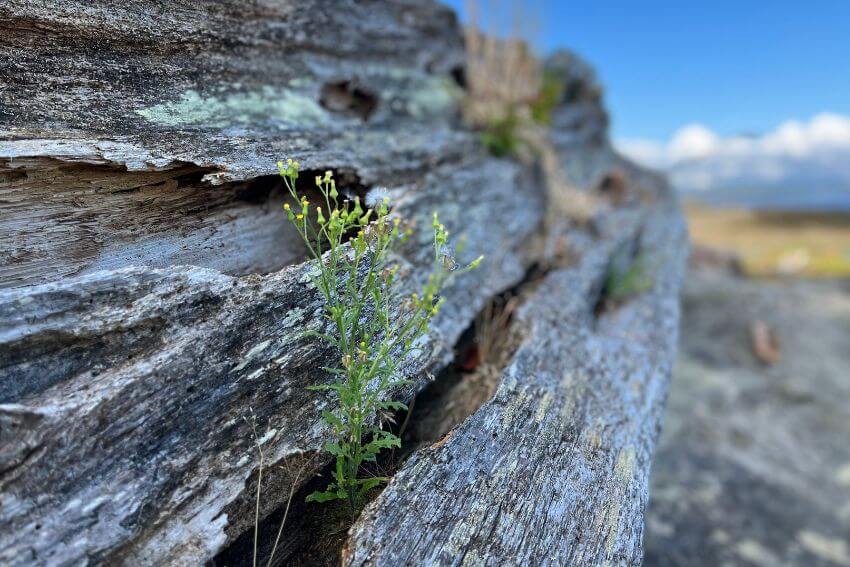
There’s a moment that happens almost every time I’m out birding in the Pacific Northwest. I’m deep in a stand of old timber, looking up for movement in the canopy, and then I’ll stop walking entirely because I’ve found one again: a massive fallen log, decades into its slow return to soil, with a fully grown tree rising straight out of its trunk.
I am mesmerized by these every single time. How does a complete, living tree grow out of something broken? Something that already fell, that already finished its life as a standing giant? It doesn’t make sense until you understand what’s actually happening underneath the moss.
It’s called a nurse log, and once you understand what it’s doing, it’s hard to look at almost anything else the same way.
What a Nurse Log Is
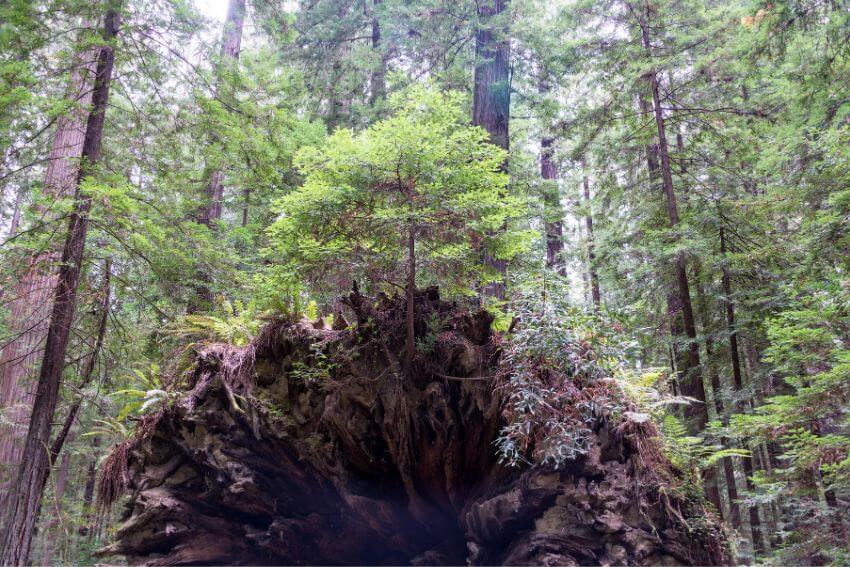
When an old Douglas fir or western red cedar falls in a Pacific Northwest forest, its story doesn’t end. The fallen trunk begins decomposing slowly, sometimes over a century, and as it softens, it becomes something new: a long mound of rich, moisture-retaining material, exactly the kind of microhabitat a seedling needs to survive its first hard years.
Look closely at one, and you’ll see the evidence in a straight line: tiny hemlock or fir saplings, huckleberry, ferns, moss, all rooted directly in the decomposing trunk of the tree that came before them. The nurse log doesn’t just disappear into the ground. It becomes exactly what the next generation needs to exist.
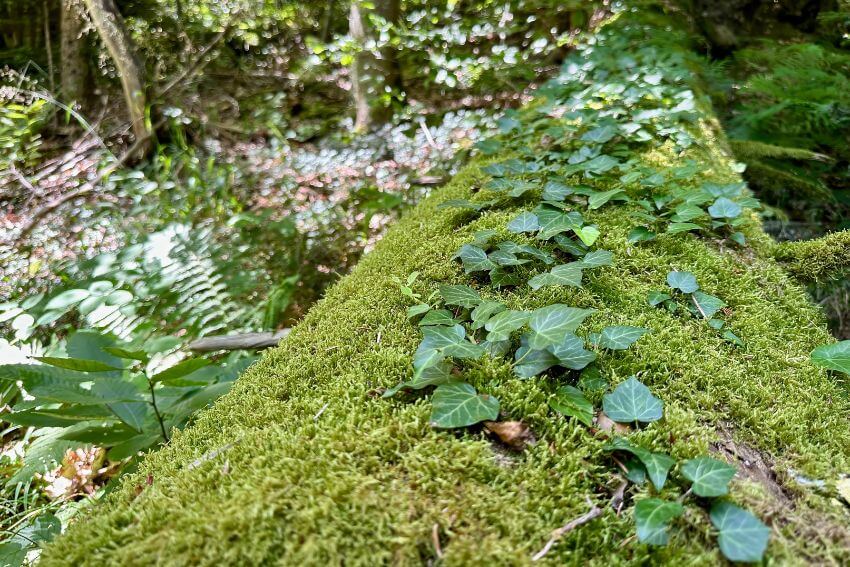
Forest ecologists have documented exactly why this happens. A decomposing log acts like a sponge, absorbing rain through the wet season and releasing it slowly through summer, staying damp long after the surrounding soil has dried out, which matters enormously to a seedling whose roots are still measured in millimeters. Moss-covered nurse logs in Oregon and Washington coastal forests have been found to retain between 48 and 98 percent of the seeds that land on them, while bare wood retains almost none. The moss isn’t decoration. It’s the seedbed.
The tree’s physical end is the direct cause of new life. Not metaphorically. Mechanically.
The Part That Sticks With Me
Here’s what I keep coming back to, standing in front of one of these: the tree gave everything it had. It didn’t hold anything back for itself, because there was no self left to hold it for. And that total release is exactly what lets an entire new ecosystem take root in its place. It took me a few of these sightings before I realized what was bothering me about the comparison to how we live.
Think about how we’re taught to think about resources. Collect more. Hold onto it. Protect it from anyone and everyone else who might want some too. That’s a scarcity mindset, and most people absorbed it so early in life that they’re not even aware it’s running quietly in the background, framing every negative thought about not having enough before they’ve had a chance to question it. We’ve built entire economic philosophies around the idea that hoarding is success and circulation is loss.
The forest disagrees completely. In a healthy ecosystem, nothing hoards. Everything moves. Water, nutrients, even the fallen bodies of the oldest trees, all of it keeps circulating through the system, and that circulation is precisely what keeps the whole forest alive.

Stephen Covey named this kind of thinking an abundance mindset, the belief that there’s enough to go around, so someone else’s gain doesn’t have to be your loss. I didn’t come up with that term, and I’m not the only one who’s written about what it means to have an abundant mindset, or about how learning to practice gratitude tends to come along with it. But standing in front of a fallen tree gave me a slightly different perspective on it, one that goes further than just believing there’s enough.
The 10X Philosophy
Here’s the personal goal I live by: when someone is kind to me, generous with me, or shares something with me I could never fully repay, my instinct is to give back ten times what I received. Not because I’m keeping score, but because that’s what circulation actually looks like between two people.
If I can’t pay someone back directly because they’re an expert and what they taught me is worth more than I could ever repay them, I pay it forward somewhere else instead. The debt doesn’t have to close the same loop it opened in. It just has to keep moving.
This isn’t about trying to win in a relationship. I don’t walk in hoping to come out ahead. I walk in giving from genuine intention, with no expectation of anything in return.
I’ve noticed this strange, wonderful phenomenon that happens when you live this way: people can feel it. They notice, sometimes without being able to name how, that your goodwill toward them is real and uncalculated, and that recognition tends to call something good out of them in return. Not because they’re competing with you. Because being on the receiving end of pure intention tends to make people want to show up the same way back.
I end up benefiting from this constantly: more loyalty, more effort, more care offered back to me than I asked for. I’m always pleasantly surprised by this because benefiting is never the plan. It’s the byproduct of sincerity, not a strategy for getting more. It’s what a virtuous cycle looks like up close, one good thing creating the conditions for another, the opposite of a vicious cycle, and it’s rare enough that when you find it, you should notice.

A Different Definition of Winning
There’s a living example of this principle operating at a scale most of us will never personally reach: MacKenzie Scott has given away more than $26 billion since 2020, including a record $7.2 billion in a single year. She gives with no strings attached, no required reports, and, famously, no buildings named after her.
Her stated philosophy borrows from a line in Annie Dillard’s The Writing Life: “The impulse to save something good for a better place later is the signal to spend it now.” Otherwise, Dillard warns, you eventually open the safe and find ashes.
That’s the nurse log, stated in a sentence. Held resources don’t preserve themselves. They just sit there, slowly turning into nothing, while a thousand things that need them go without.
Scott isn’t circulating her wealth because she calculated it was the optimal strategy. She’s doing it because she apparently understands something the forest already knew: what you hold onto past the point you can use it doesn’t actually become more valuable. It becomes inert. What you let move keeps creating more of itself, in other people, in other places, long after you’ve let go of it. Her own well-being doesn’t seem to depend on the number getting bigger. It seems to depend on watching it move.
Becoming the Nurse Log
None of this requires a fortune. The forest isn’t only made of giant fallen trees. It’s also made of every small thing that decided to give what it had rather than hold it: the fern that drops its spores into the rot, the woodpecker that hollows out a cavity another creature will later use as a home, the moss that holds just enough moisture for a seed three inches away to survive its first dry week.
You don’t need to be remarkable to circulate. You just need to stop believing that holding on is the safer move.
Here’s what you can do. You can stay a few extra minutes to help a co-worker who’s drowning in a deadline, or be the one in your family who actually shows up for your kids or your aging parents. You can tell one of the good people in your life exactly why they matter to you instead of assuming they already know. When sitting down to talk to a friend, you can actively listen to what they’re saying, instead of half-listening while you wait for your turn. Time, energy, and attention — none of it requires money. All any of this requires is something small, ordinary, and completely within reach.

When someone is generous with you, look for a way to be ten times as generous back, to them if you can, to someone else if you can’t.
Notice when you’re tempted to hold something back out of fear there won’t be enough left for you. Give it anyway, and watch what grows.
What the Fallen Tree Knows
The nurse log never calculated whether giving everything away was the optimal move. It just fell, and softened, and let go, and something else grew because of it. It didn’t do the math on what it was owed.
Next time you’re out walking and you find one, a moss-covered log with a sapling rising straight out of its trunk, stop for a second the way I always do. Notice that the most generous thing in the entire forest is the one that’s already finished, lying down, holding nothing back.
Then go be one, while you’re still standing.